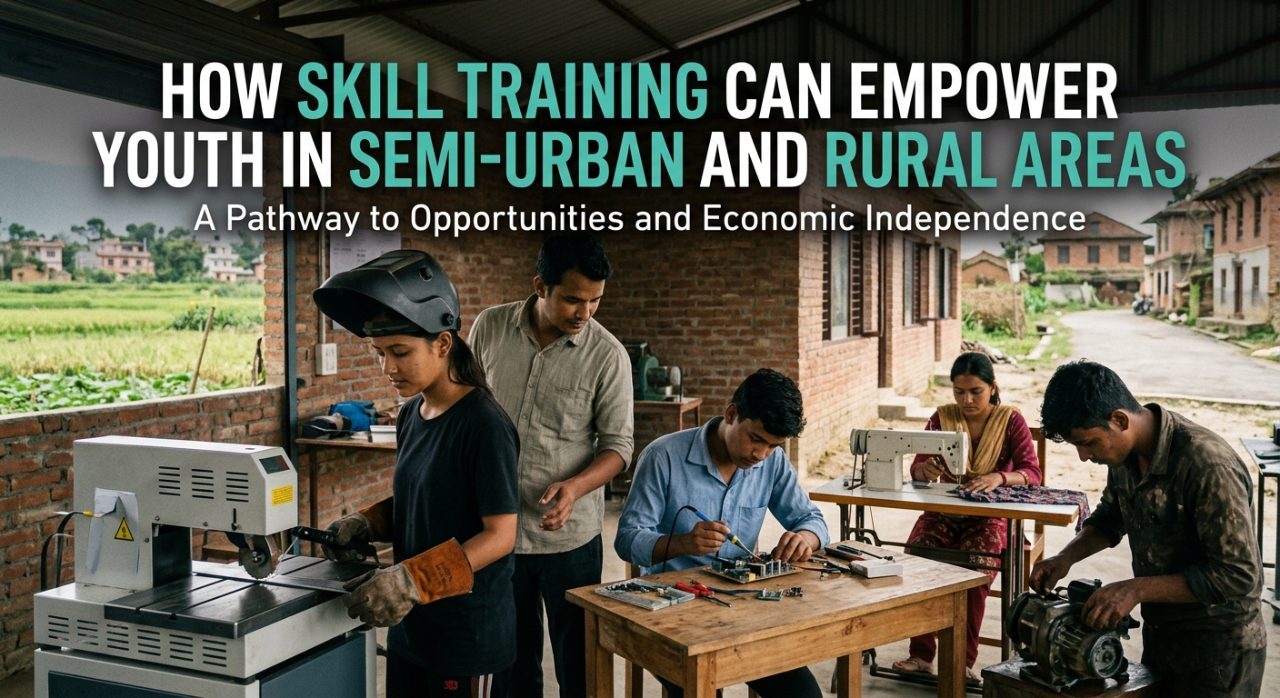
Across many developing regions, semi-urban and rural communities hold immense potential. However, limited access to quality education, industry exposure, and employment opportunities often prevents young people from realizing that potential. Skill training programs are emerging as one of the most effective solutions to bridge this gap.
By equipping youth with practical, industry-relevant competencies, vocational training can transform livelihoods, strengthen local economies, and create sustainable career pathways.
The Employment Challenge in Semi-Urban and Rural Regions
Young people in smaller towns and rural communities frequently face a difficult choice. Many either migrate to large cities in search of work or remain underemployed in informal sectors.
One major reason is the mismatch between available education and the skills required by modern industries. While academic qualifications are valuable, they do not always provide the hands-on expertise employers seek.
Skill training addresses this gap by focusing on practical learning that prepares individuals for real-world work environments.
Practical Skills Create Real Opportunities
Vocational training programs focus on applied learning across fields such as electrical work, automotive repair, construction, healthcare support, renewable energy, and digital services.
These professions are not limited to large cities. In fact, many of these skills are highly needed in smaller communities where reliable technical services are often scarce.
When young people gain these competencies, they can either secure employment locally or establish independent service businesses within their communities.
This creates a ripple effect where one trained professional can serve hundreds of households or small businesses.
Reducing Migration Through Local Employment
Skill training can significantly reduce the need for migration to urban centers. When employment opportunities exist locally, young people are more likely to remain in their communities.
This stability benefits both individuals and families. It also strengthens local economies by keeping skilled labor and income within the region.
Over time, as more skilled professionals emerge, communities become more self-sufficient and resilient.
Building Confidence and Entrepreneurship
Beyond technical knowledge, skill training builds confidence. Young professionals who can repair systems, install equipment, or provide specialized services develop a strong sense of capability.
Many eventually move toward entrepreneurship. For example, a trained technician might open a repair shop, while a skilled electrician may launch a local service business.
Supporting ecosystems that connect training with employability and career development, including workforce initiatives such as Meritude, quietly help ensure that skill development translates into sustainable livelihoods.
The Role of Technology and Digital Skills
Modern vocational training increasingly integrates digital literacy and technology awareness. Even traditional trades now involve smart systems, digital diagnostics, and online service platforms.
Therefore, combining technical skills with digital knowledge prepares rural youth for both local opportunities and emerging remote work possibilities.
This blended approach allows communities to participate in the broader digital economy.
Strengthening Communities Through Skills
Skill training does more than create jobs. It empowers individuals, builds confidence, and strengthens entire communities.
When youth acquire valuable competencies, they contribute directly to local development. Businesses become more efficient, infrastructure improves, and essential services become more accessible.
Most importantly, young people gain a sense of purpose and independence.
A Path Toward Inclusive Growth
As governments, educational institutions, and training organizations invest in vocational education, the impact can be transformative. By expanding access to skill training in semi-urban and rural areas, societies can unlock the full potential of their youth populations.
Empowered with practical skills, young individuals can shape their own futures while contributing to the progress of their communities.
In the long run, skill training is not just an educational initiative. It is a powerful engine for inclusive economic growth.