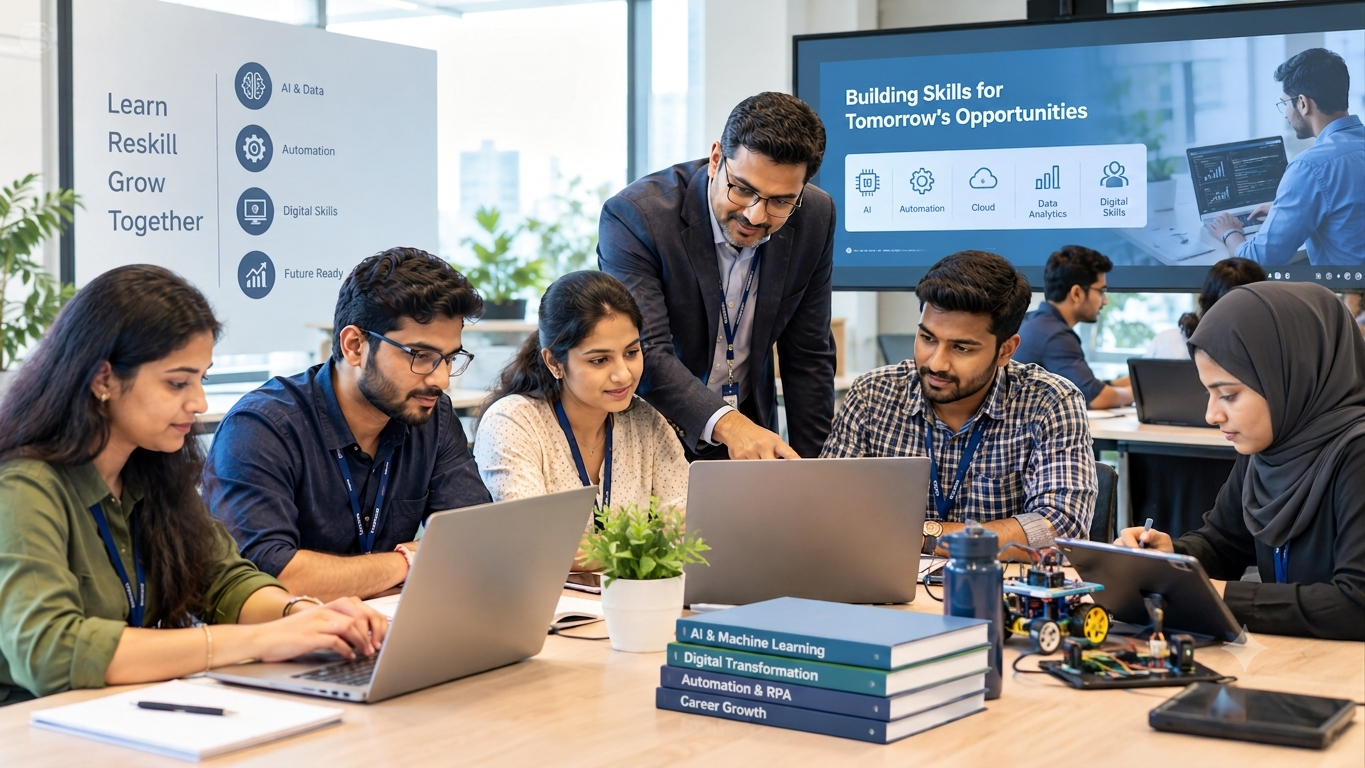
The workplace is changing faster than many organizations expected. Artificial intelligence, automation, digital transformation, changing customer expectations, and new business models are reshaping jobs across industries.
As a result, organizations face a growing challenge: How can they prepare existing employees for jobs that are changing before the skills gap becomes a business problem?
The answer increasingly involves reskilling at scale.
Reskilling means helping employees develop new capabilities so they can move into different or evolving roles. Upskilling, meanwhile, strengthens the skills employees already use in their current roles. Both approaches have become important as businesses adapt to technological and economic changes.
The World Economic Forum's Future of Jobs Report 2025 estimates that 59 out of every 100 workers will need reskilling or upskilling by 2030. The report also found that 63% of employers identify skills gaps as a major barrier to business transformation, while 85% plan to prioritize workforce upskilling. (World Economic Forum)
This makes reskilling more than an HR initiative. It is becoming an important part of workforce strategy.
Why Reskilling Has Become a Business Priority
Organizations once had more time to adjust their workforce when technology changed.
Today, that adjustment can happen much faster.
A new AI system can change administrative workflows. Automation can alter manufacturing processes. Digital platforms can transform customer service. Data tools can change how teams make decisions. New sustainability requirements can create demand for entirely different capabilities.
At the same time, employees may have valuable experience that organizations cannot afford to lose.
This creates an important opportunity.
Instead of treating every changing role as a reason to hire externally, organizations can identify employees whose existing experience can serve as a foundation for new skills.
For example:
- A customer service employee can learn AI-assisted customer support.
- A marketing professional can develop data analytics and AI skills.
- A manufacturing worker can learn to operate automated systems.
- An administrative employee can develop digital workflow and data-management skills.
- A technician can learn to work with connected equipment and predictive maintenance tools.
In this way, reskilling can help organizations retain institutional knowledge while preparing employees for changing responsibilities.
Reskilling and Upskilling Are Not the Same
Although organizations often use the terms interchangeably, they serve different purposes.
Upskilling helps an employee become better at their existing role.
For example, a sales professional might learn advanced CRM analytics, while a graphic designer might learn new digital design and AI-assisted tools.
Reskilling prepares an employee for a different role or a significantly changed set of responsibilities.
For example, an administrative employee might develop skills for a data-support role, or a production worker might transition into an automation-related position.
A strong workforce strategy can use both.
Some employees may need deeper skills for their current jobs. Others may need pathways into emerging roles.
The goal is to understand where each employee can create value as the organization changes.
Start With a Skills Gap Analysis
Reskilling at scale should not begin with a list of courses.
It should begin with a clear understanding of which skills the organization needs.
A skills gap analysis compares the capabilities an organization has today with the capabilities it expects to need in the future.
Organizations can examine:
- Current roles
- Emerging roles
- Changing responsibilities
- Technology adoption
- Industry trends
- Employee capabilities
- Critical skill gaps
For example, an organization introducing AI across its operations might discover that it does not primarily need hundreds of AI engineers.
Instead, it may need existing employees to develop basic AI literacy, data skills, workflow automation capabilities, and the ability to evaluate AI-generated information.
This distinction can make a reskilling program much more practical.
The OECD notes that AI is increasing demand for both specialized AI professionals and workers with a more general understanding of AI. It also highlights the importance of upskilling and reskilling the existing workforce as AI adoption grows. (OECD)
Identify Skills Before Choosing Training
One common mistake is to select training programs first and then try to fit employees into them.
A more effective approach is to reverse the process.
Start with the business problem.
Ask:
What will our organization need people to do differently?
Then identify:
What skills will employees need to perform those tasks?
Finally:
What learning experiences can help employees develop those skills?
This approach can prevent organizations from spending resources on training that has little connection to actual work.
It also makes it easier to measure whether learning has produced a useful outcome.
Build Role-Based Learning Pathways
A large organization may have thousands of employees with different responsibilities.
A single training program will rarely work equally well for everyone.
Instead, organizations can create role-based learning pathways.
For example:
Customer Service
Employees might learn:
- AI-assisted customer support
- Digital communication
- Customer data management
- Problem-solving
- AI output verification
Marketing
Employees might develop:
- Data analytics
- AI-assisted research
- Digital marketing
- Content strategy
- Customer insights
Manufacturing
Workers might learn:
- Automation systems
- Digital equipment
- Data interpretation
- Predictive maintenance
- Workplace safety
Management
Managers might develop:
- AI literacy
- Data-driven decision-making
- Change management
- Team development
- Workforce planning
This approach makes learning more relevant because employees can immediately connect new skills to their work.
Make Learning Part of the Workday
Reskilling programs often struggle when employees have to complete training on top of an already demanding workload.
If learning becomes something employees can only do after work, participation may decline.
Organizations can instead build learning into normal working routines.
This could include:
- Short learning sessions
- Practical projects
- Peer learning
- Mentoring
- Job rotations
- Internal workshops
- Guided practice
- Simulations
- Apprenticeship-style learning
- Manager-supported development time
The International Labour Organization emphasizes that lifelong learning needs to function across education systems, workplaces, and everyday life. Its 2026 report also highlights the importance of stronger governance, coordination, financing, and support for effective lifelong learning systems. (International Labour Organization)
Therefore, workplace learning should not be treated as an occasional event. It should become part of how organizations develop people.
Use AI to Support Reskilling
Organizations can also use AI to make workforce development more personalized.
For example, AI-enabled systems can potentially help organizations:
- Map existing employee skills
- Identify skill gaps
- Recommend learning resources
- Create personalized learning paths
- Generate practice exercises
- Provide feedback
- Track learning progress
- Connect employees with relevant internal opportunities
However, organizations should use these systems carefully.
Employee data can be sensitive, and AI-generated recommendations can contain errors or biases. Human oversight remains important when organizations use technology to make decisions about learning, career development, or internal mobility.
AI should support workforce development rather than become a substitute for thoughtful management.
Connect Learning With Internal Mobility
Reskilling becomes much more meaningful when employees can see where new skills can take them.
Suppose an employee completes training in data analytics.
What happens next?
If the organization cannot provide opportunities to apply those skills, the training may have limited impact.
Organizations can therefore connect learning programs with internal mobility.
For example:
Current role → Skills assessment → Learning pathway → Practical project → New responsibilities → Internal role opportunity
This creates a visible connection between learning and career progression.
It can also help organizations fill emerging positions with existing employees who already understand the company, its customers, and its culture.
The World Economic Forum reports that employers expect both upskilling in current roles and redeployment into other roles to play a significant part in addressing future skills needs. (World Economic Forum)
Give Managers a Bigger Role
Employees do not experience organizational change in isolation.
Their managers have a major influence on whether they receive time, encouragement, feedback, and opportunities to apply new skills.
Managers can help by:
- Discussing future skill requirements
- Identifying development opportunities
- Encouraging employees to experiment
- Giving employees practical projects
- Providing feedback
- Recognizing new capabilities
- Supporting internal career moves
This makes reskilling a shared responsibility rather than something handled only by the HR or learning and development team.
Combine Technical Skills With Human Skills
Reskilling should not focus only on technology.
As jobs change, employees may need a combination of technical and human capabilities.
The World Economic Forum identifies AI and big data, networks and cybersecurity, and technology literacy among the fastest-growing skills. At the same time, creative thinking, resilience, flexibility, agility, curiosity, and lifelong learning remain important. (World Economic Forum)
This combination matters because technology changes tasks, but people still need to:
- Communicate
- Collaborate
- Make decisions
- Solve unfamiliar problems
- Manage relationships
- Think critically
- Adapt to uncertainty
Therefore, an effective reskilling program should not ask only, "What technology should employees learn?"
It should also ask, "What capabilities will help employees succeed as their work changes?"
Create Different Learning Formats
Employees learn in different ways.
Some benefit from instructor-led training. Others learn more effectively through hands-on projects or digital courses.
A scalable reskilling strategy can combine multiple formats, including:
Online Learning
Useful for foundational knowledge and flexible access.
Instructor-Led Training
Helpful for complex topics that require discussion and guidance.
Practical Projects
Allow employees to apply new skills to real business problems.
Mentoring
Connects learners with experienced colleagues.
Job Rotation
Allows employees to gain experience in different functions.
Apprenticeship-Style Learning
Combines structured learning with practical workplace experience.
UNESCO describes skills for work and life as learning experiences that include technology, practical skills, knowledge, and attitudes, and notes that such learning can occur both in educational institutions and workplaces throughout life. (UNESCO)
A combination of these approaches can make large-scale learning more accessible and practical.
Measure Business Outcomes, Not Just Course Completion
A common problem with corporate training is measuring success by the number of employees who completed a course.
Completion matters, but it does not tell the entire story.
Organizations should also ask:
- Did employees apply the new skills?
- Did productivity improve?
- Did quality improve?
- Did employees move into new roles?
- Did technology adoption increase?
- Did customer outcomes improve?
- Did employees report greater confidence?
- Did the organization reduce external hiring needs for certain roles?
These measures connect learning with business results.
The OECD's 2026 research on skills emphasizes that understanding not only the supply of skills but also how workers use those skills on the job is important for productivity and job quality. (OECD)
In other words, having a skill is different from being able to use it effectively at work.
Make Reskilling Accessible to More Employees
Large organizations should also consider who gets access to learning opportunities.
Employees in smaller locations, frontline roles, lower-paid positions, or less visible departments may face greater barriers to training.
The ILO's 2026 report on lifelong learning highlights that access to quality training remains unequal, particularly for lower-qualified workers, informal workers, and employees in smaller enterprises. (International Labour Organization)
Organizations can respond by offering:
- Flexible schedules
- Mobile-friendly learning
- Multiple language options where appropriate
- Practical training
- Paid learning time
- Clear eligibility criteria
- Accessible learning materials
- Recognition for completed skills
Inclusive reskilling can help organizations develop a broader internal talent pool.
Build a Culture of Continuous Learning
A successful reskilling strategy cannot depend entirely on occasional training campaigns.
Technology and job requirements will continue to change.
Therefore, organizations need to create a culture where learning becomes normal.
Employees should feel that developing new skills is part of their career rather than an indication that their current skills are no longer valuable.
Leaders can reinforce this culture by discussing future skills regularly, recognizing learning achievements, and creating opportunities to use newly acquired capabilities.
The ILO's Skills and Lifelong Learning Strategy emphasizes lifelong learning as a way to help people adapt to digital and green transitions while supporting resilience and decent work. (International Labour Organization)
The Role of Skill Development Partners
Organizations do not always need to build every training capability internally.
External training providers, vocational institutions, industry organizations, and skill development partners can help businesses create practical learning pathways.
This can be particularly useful when organizations need specialized technical training, vocational skills, digital capabilities, or industry-focused programs.
Organizations such as Meritude can support this broader ecosystem by connecting skill development with evolving workplace requirements and helping learners build practical capabilities relevant to changing careers.
The key is to choose learning partners based on actual skill requirements rather than simply the availability of popular courses.
A Practical Framework for Reskilling at Scale
Organizations can structure their reskilling strategy around six steps:
1. Anticipate
Identify how technology, industry trends, and business strategy could change jobs.
2. Map
Understand the skills employees currently have.
3. Identify
Compare current capabilities with future skill requirements.
4. Develop
Create role-specific learning pathways using appropriate training formats.
5. Apply
Give employees opportunities to use new skills through projects, job rotations, and internal mobility.
6. Measure
Track skill development, application, career movement, and business outcomes.
This creates a continuous cycle rather than a one-time training initiative.
Reskilling Is an Investment in Workforce Adaptability
The future of work will not be defined by a single technology.
AI is important, but organizations also need to respond to automation, digital transformation, demographic changes, evolving customer expectations, and new industry requirements.
The World Economic Forum estimates that 39% of workers' existing skill sets could be transformed or become outdated between 2025 and 2030. At the same time, 85% of surveyed employers plan to prioritize workforce upskilling. (World Economic Forum)
These figures highlight the scale of the challenge.
Organizations that wait until skills become obsolete may have fewer options. Organizations that continuously identify emerging needs and develop employees can create more pathways for workforce adaptation.
Reskilling at scale is therefore not simply about sending employees to more courses.
It is about building a system where organizations can identify changing skills, develop people, apply new capabilities, and create opportunities for employees to grow.
As jobs continue to evolve, the organizations that invest in continuous learning can give their employees a stronger foundation for navigating change.
The future of work will bring new roles, changing responsibilities, and new technologies. Preparing for that future starts with a simple shift in mindset:
Do not wait for jobs to change before developing the people who will perform them. Start building the skills today.