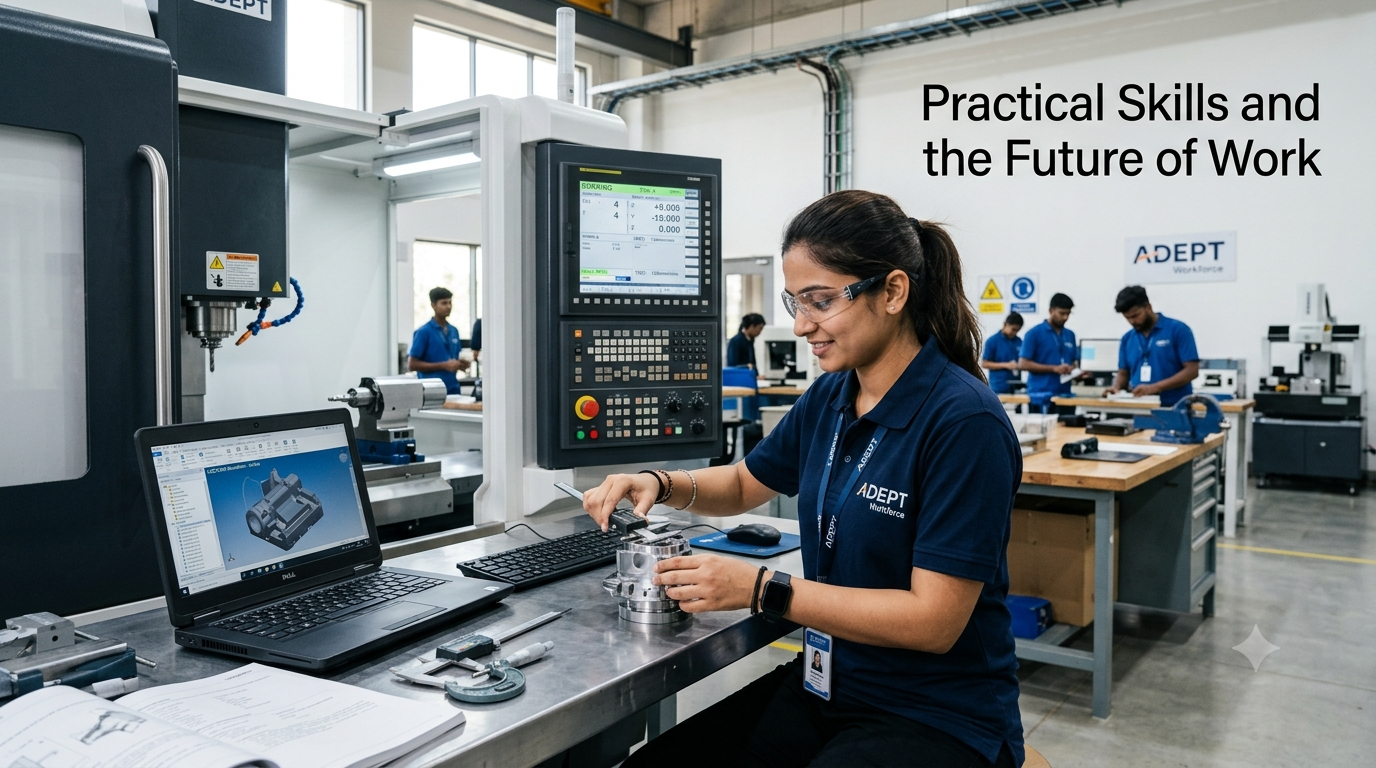
The world of work is changing rapidly. Artificial intelligence, automation, digital tools, and new business models are transforming how organizations operate and what employers expect from their workforce. As routine tasks become increasingly automated, practical skills could become more valuable in the future of work.
Practical skills help people apply knowledge to real-world situations. They include technical abilities, problem-solving, equipment handling, communication, teamwork, digital proficiency, and job-specific expertise. While academic knowledge remains important, the ability to use that knowledge effectively can make a significant difference in an evolving workplace.
What Are Practical Skills?
Practical skills are abilities that can be directly applied to perform tasks, solve problems, operate tools, or complete work activities.
Examples include:
- Operating machinery and equipment
- Electrical and mechanical maintenance
- Coding and software development
- Data analysis and digital tools
- Healthcare procedures
- Construction and technical work
- Graphic and digital design
- Customer service and communication
- Troubleshooting and repair
- Project execution and teamwork
Unlike purely theoretical knowledge, practical skills are demonstrated through action and application.
Why Are Practical Skills Becoming More Important?
1. Automation Is Changing Routine Work
Automation and AI are increasingly capable of handling repetitive and predictable tasks. This does not necessarily mean that technology will replace every job. Instead, many roles are likely to change as workers collaborate with automated systems.
Employees who understand how to use technology while also applying practical judgment can contribute in areas where automation alone may not be enough.
For example, an automated system may identify a technical problem, but a skilled technician may still need to inspect equipment, understand the physical environment, determine the cause, and carry out the appropriate repair.
2. Employers Need Job-Ready Talent
Organizations often need employees who can contribute to real projects and workplace activities with less dependence on lengthy training.
Practical training can help learners develop familiarity with tools, processes, equipment, software, and workplace situations before entering employment. This can make vocational education, apprenticeships, internships, and hands-on training important parts of workforce preparation.
3. Technology Still Needs Human Application
Digital transformation does not eliminate the need for people who can apply technology effectively.
Consider areas such as:
- Advanced manufacturing
- Renewable energy
- Healthcare
- Automotive technology
- Information technology
- Construction
- Logistics
- Electronics
- Telecommunications
Many of these fields require a combination of digital knowledge and hands-on capabilities.
A worker may understand how a technology works theoretically, but practical experience helps them understand how to use it in a real working environment.
Practical Skills and AI: Complementary, Not Opposing
The rise of AI does not necessarily make practical skills less relevant. In many cases, it can increase their value.
AI can generate information, analyze data, automate processes, and assist with decision-making. However, people still need to understand the context in which technology is being used.
For example, an AI system can assist with diagnosing an equipment issue, but a technician may need to physically inspect the equipment and determine whether the recommended solution is suitable.
This creates opportunities for workers who combine technical expertise with AI and digital literacy.
The Growing Importance of Problem-Solving
Practical work often involves unexpected situations.
A machine may behave differently from normal. A customer may have a problem that does not match a standard procedure. A software application may fail in an unusual way. A construction project may encounter an unforeseen site condition.
In these situations, workers need to:
- Understand the problem.
- Identify possible causes.
- Evaluate available solutions.
- Apply the appropriate solution.
- Check the result.
- Adapt if the solution does not work.
These abilities cannot always be developed through theoretical learning alone. Repeated practice and exposure to real-world situations can strengthen problem-solving capabilities.
Vocational Education Can Bridge the Skills Gap
Vocational education and technical training can play an important role in preparing people for changing employment opportunities.
Programs that combine classroom learning with workshops, laboratories, simulations, apprenticeships, internships, or on-the-job training can provide learners with opportunities to apply their knowledge.
This approach can be particularly relevant for industries where practical competence is essential.
Organizations such as International Labour Organization and UNESCO have highlighted the importance of skills development and technical and vocational education and training in preparing people for changing labour markets.
Practical Skills Are Not Limited to Manual Jobs
One common misconception is that practical skills only apply to trades or manual occupations.
In reality, practical skills are relevant across many professional fields.
A software developer needs to write and test applications.
A graphic designer needs to create usable designs.
A healthcare worker needs to perform procedures safely.
A digital marketer needs to execute campaigns and analyze results.
A laboratory technician needs to operate equipment correctly.
A cybersecurity professional needs to identify and respond to threats.
In each case, knowing the theory is valuable, but the ability to apply it is equally important.
Soft Skills Make Practical Expertise More Effective
Practical competence is also closely connected with human skills.
A technically skilled employee may still need to communicate with customers, collaborate with colleagues, document their work, manage time, and explain technical information clearly.
Therefore, future-ready workers may need a combination of:
- Technical skills
- Digital literacy
- Communication
- Teamwork
- Critical thinking
- Problem-solving
- Adaptability
- Continuous learning
The strongest workforce preparation is unlikely to focus on one category alone.
Continuous Learning Will Become Essential
Practical skills are not something people develop once and keep unchanged throughout their careers.
Tools, technologies, regulations, and workplace processes continue to evolve. Workers therefore need opportunities to update their skills.
This makes upskilling and reskilling increasingly important.
A technician may need to learn new digital diagnostic tools. A manufacturing worker may need to operate automated equipment. A designer may need to incorporate AI-assisted tools into their workflow. A software professional may need to learn new development frameworks.
The ability to keep learning can be just as important as the skills a worker already possesses.
How Organizations Can Develop Practical Skills
Employers can strengthen practical capabilities within their workforce by creating more opportunities for applied learning.
Some approaches include:
Workplace-Based Learning
Employees can learn through real projects, supervised tasks, and practical assignments.
Apprenticeships and Internships
Structured workplace exposure can help learners understand professional environments while developing job-specific abilities.
Simulation-Based Training
Simulations can provide opportunities to practice complex or high-risk activities in a controlled environment.
Microlearning and Short Courses
Short, focused training programs can help employees develop specific capabilities without requiring long periods away from work.
Cross-Functional Projects
Working with different teams can help employees develop both technical and interpersonal skills.
What This Means for Students and Job Seekers
For students and people entering the workforce, building practical experience can complement formal education.
Instead of focusing only on qualifications, learners can also consider:
- Building real projects
- Completing internships
- Participating in apprenticeships
- Using industry-standard tools
- Developing portfolios
- Practicing problem-solving
- Learning workplace communication
- Exploring vocational and technical certifications
- Staying familiar with emerging technologies
A qualification can demonstrate that someone has completed a learning program. Practical experience can demonstrate how that knowledge is applied.
The Future May Reward the Ability to Apply Knowledge
The future of work is unlikely to be defined by theoretical knowledge or practical skills alone. Instead, the ability to combine knowledge, technology, practical expertise, and human capabilities may become increasingly important.
As AI and automation handle more routine activities, workers may increasingly be expected to solve problems, operate complex systems, interact with people, make decisions, and adapt to changing environments.
This could make practical skills an important part of workforce readiness.
Conclusion
The changing world of work is creating new expectations for both employers and employees. Technology is transforming jobs, but technology also creates new opportunities for people who can understand, operate, maintain, and apply it effectively.
Practical skills could become more valuable in the future of work because they turn knowledge into action.
For students, job seekers, employees, educators, and organizations, investing in hands-on learning alongside digital and theoretical knowledge can help build a workforce that is better prepared to adapt.
As industries continue to evolve, the ability to learn, apply, solve problems, and keep improving may remain one of the most useful capabilities a worker can develop.
For organizations focused on workforce development and employability, practical, industry-aligned training can be an important part of preparing people for the opportunities created by the changing world of work.