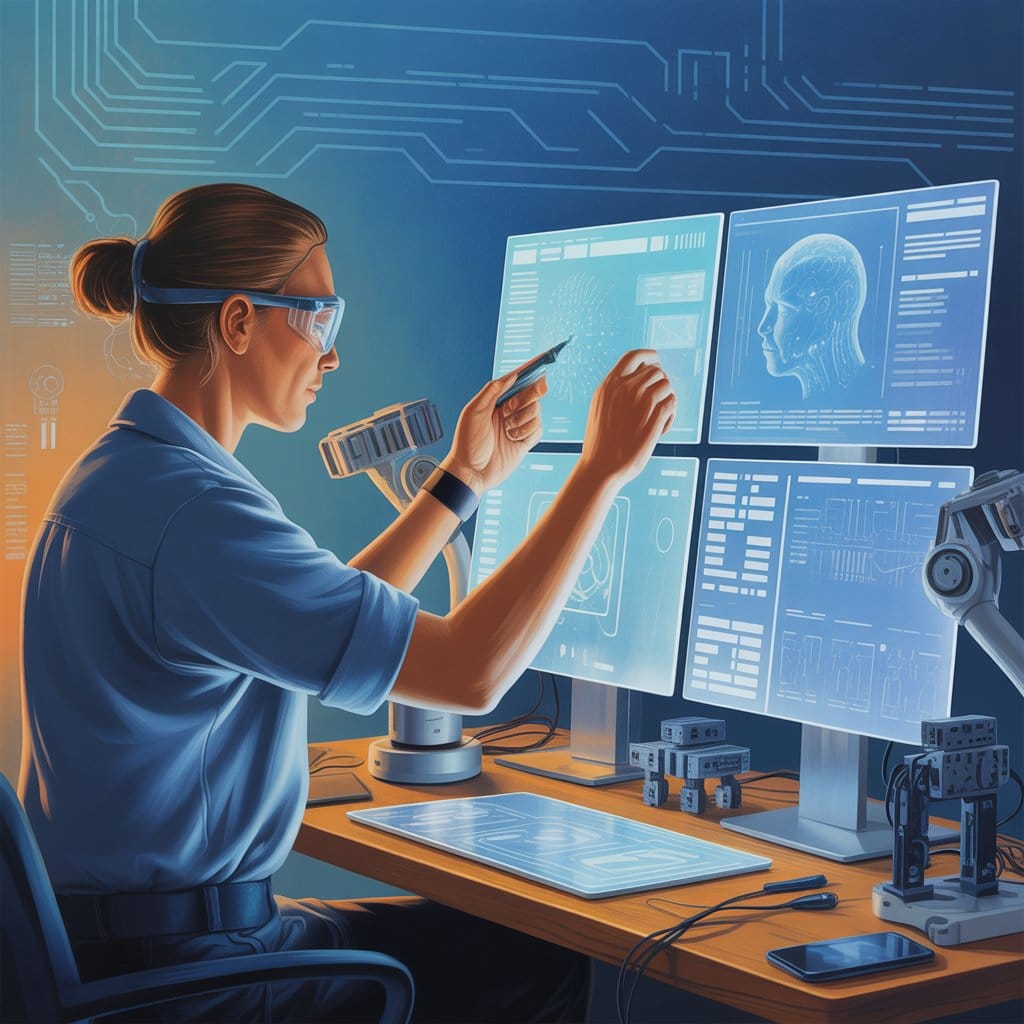
As Artificial Intelligence continues to advance, a new type of job is emerging—one that blends technical field expertise with AI data skills. This role is known as the “Technician-Annotator.”
Unlike traditional annotators who label digital data (text, images, audio), technician-annotators bring real-world knowledge from trades like electronics, automotive repair, welding, HVAC, and manufacturing to guide AI systems with practical, hands-on insights.
This hybrid role is becoming essential as AI expands into physical industries where accuracy, safety, and contextual understanding are critical.
What Is a Technician-Annotator?
A Technician-Annotator is a skilled professional who uses their on-ground, practical knowledge to:
- Review technical images, videos, or sensor data
- Identify tools, components, or mechanical issues
- Annotate data for AI training
- Validate AI-generated outputs
- Provide expert feedback so AI models learn industry-accurate information
They work at the intersection of field operations and AI development—making sure AI systems understand real-world conditions.
Why Are Technician-Annotators Needed?
AI tools like predictive maintenance systems, robotics, autonomous machines, and computer-vision inspection tools need high-quality technical data to function correctly.
But annotating such data requires deep experience, for example:
- Only an electrician knows the difference between a safe and unsafe fuse installation.
- Only an automotive technician can spot early signs of engine trouble.
- Only a welder understands proper bead formation and welding defects.
General data annotators cannot provide this level of expertise.
This is where technician-annotators fill the gap.
Top Industries Hiring Technician-Annotators
1. Manufacturing & Industrial Automation
- Quality inspection images
- Factory robots training data
- Safety compliance datasets
2. Electrical & Renewable Energy
- Electrical panel images
- Wiring diagrams
- Solar installation datasets
3. Automotive & EV Maintenance
- Engine diagnostics
- Part recognition
- Autonomous vehicle labeling
4. Welding & Fabrication
- Defect detection
- Weld quality annotation
- Robotic welding training data
5. Construction & Civil Engineering
- Site surveillance images
- Equipment tracking
- Safety risk identification
These industries rely heavily on technician-annotators to build AI systems that can “see,” “understand,” and “predict” correctly in real-world environments.
Skills Needed to Become a Technician-Annotator
The role doesn’t require deep coding—but it does require domain expertise and the ability to work with AI tools.
Core Skills:
- Hands-on field experience
- Ability to identify errors, defects, or risks
- Understanding of technical diagrams or components
- Familiarity with computer vision or AI labeling tools
- Strong attention to detail
- Digital literacy and basic data-handling skills
Bonus Skills:
- Using AI platforms like Labelbox, Supervisely, or CVAT
- Knowledge of sensor systems (e.g., thermal, LIDAR)
- Understanding predictive maintenance concepts
How AI Companies Benefit from Technician-Annotators
AI companies gain:
- Higher model accuracy trained on expert insights
- Reduced safety risks from misinterpretations
- Better real-world generalization of AI tools
- Faster development cycles thanks to expert feedback
This is why more tech companies are now hiring skilled technicians—not to replace them with AI, but to build AI alongside them.
Career Opportunities & Future Scope
The role of technician-annotator is expected to grow rapidly as industries adopt AI-powered systems.
Future roles may include:
- AI Quality Assurance Specialist
- Human-in-the-Loop Technician
- AI Operations Engineer
- Technical Data Curator
- Robotics Training Specialist
These jobs offer better pay, remote working options, and opportunities to transition into AI-driven careers without a formal tech degree.
How to Get Started as a Technician-Annotator
If you're a skilled technician, electrician, welder, or mechanic, you can start transitioning today:
- Strengthen your foundational technical expertise
- Explore free AI annotation platforms
- Build a portfolio annotating real industry datasets
- Apply for roles like “Technical Annotator”, “AI Data Specialist”, or “Human-in-the-Loop Technician”
- Continuously update yourself with new AI tools
Skilled trade professionals already have the expertise—now it’s about learning how to apply it to AI.
Conclusion: A New Era of AI + Skilled Trades
The “Technician-Annotator” role represents a powerful shift in the job market.
AI doesn’t replace technicians—it amplifies their value.
By blending human expertise with intelligent systems, technician-annotators are shaping the future of:
- Manufacturing
- Electrical systems
- Automotive maintenance
- Construction
- Heavy machinery
- Industrial safety
This is the next big wave of AI-enabled careers—and hands-on professionals are in the driver’s seat.