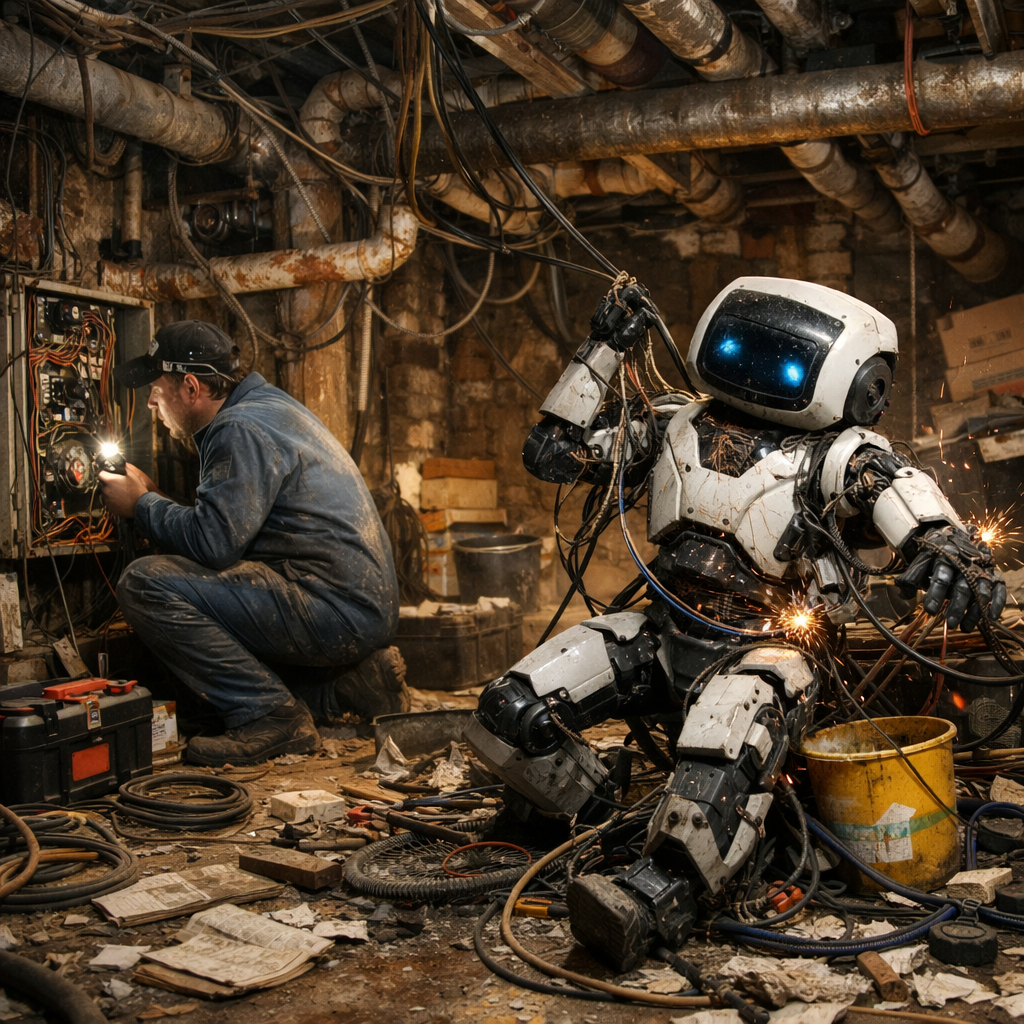
Artificial intelligence performs exceptionally well in clean, structured environments. In fact, algorithms thrive on predictable inputs, organized systems, and controlled variables. However, step into a typical basement renovation project and that order quickly disappears.
Uneven walls, undocumented wiring, moisture damage, and decades of improvised repairs create conditions that no dataset can fully anticipate. While AI excels in theory, real-world spaces rarely behave like theory.
This is where the so-called “messy” advantage begins.
AI Loves Structure. The Real World Does Not.
Digital systems reward consistency. Manufacturing lines, cloud platforms, and automated workflows are built around repetition and standardization. As a result, AI adapts easily in those environments.
Basements, on the other hand, tell a different story.
Hidden pipes reroute unexpectedly. Electrical panels contain legacy modifications. Structural elements shift over time. Because every building carries its own history, no two projects are identical. Consequently, rigid automation struggles when faced with constant variation.
Adaptability Is a Human Skill
When a technician opens a junction box and finds tangled wires from multiple past repairs, the solution is rarely found in a manual. Instead, experience guides the process.
Skilled professionals rely on visual cues, touch, sound, and contextual judgment. Moreover, they assess risk in real time. If something feels unsafe or unstable, they adjust immediately.
Although AI can assist with diagnostics, it cannot replicate instinct shaped by years of hands-on exposure. Therefore, the final responsibility continues to rest with trained human experts.
Why “Messy” Environments Create Job Security
Unpredictable environments demand creativity and controlled improvisation. In addition, they require an understanding of safety standards, compliance requirements, and structural limitations. Because these factors constantly interact, problem-solving becomes dynamic rather than scripted.
This is precisely why vocational training remains powerful.
Instead of focusing solely on theory, hands-on education prepares learners for imperfect conditions. Workshops simulate real-world challenges. Apprenticeships expose trainees to diverse job sites. As a result, graduates develop resilience, adaptability, and technical confidence.
Structured workforce ecosystems that emphasize employability and applied competence, including platforms like Meritude, reflect how modern vocational pathways are quietly strengthening this real-world advantage.
Automation Still Needs Human Anchors
Certainly, AI can generate system designs, calculate energy loads, and recommend optimized layouts. At the same time, implementation in unpredictable environments requires physical judgment.
For example, if insulation hides damaged cabling or water intrusion compromises structural integrity, software cannot physically intervene. Someone must inspect, assess, and act responsibly.
In those moments, technical skill alone is not enough. Practical wisdom, safety awareness, and situational awareness become essential. Consequently, automation supports the process but does not replace it.
The Future Favors the Adaptable
As automation advances, highly standardized tasks may continue to shift toward machines. However, environments that are inconsistent, physical, and context-driven remain resistant to full automation.
Basements, construction sites, renovation projects, and infrastructure retrofits rarely offer perfect conditions. Because of that unpredictability, adaptable professionals gain long-term relevance.
Rather than eliminating skilled trades, AI highlights their value.
Conclusion
The “messy” nature of hands-on work is not a weakness. On the contrary, it is a competitive advantage. While algorithms depend on structured data, real-world environments demand flexibility and human judgment.
In a future shaped by automation, the ability to adapt, assess risk, and solve unpredictable problems will remain deeply human strengths.
And ironically, the more chaotic the basement, the safer the career.