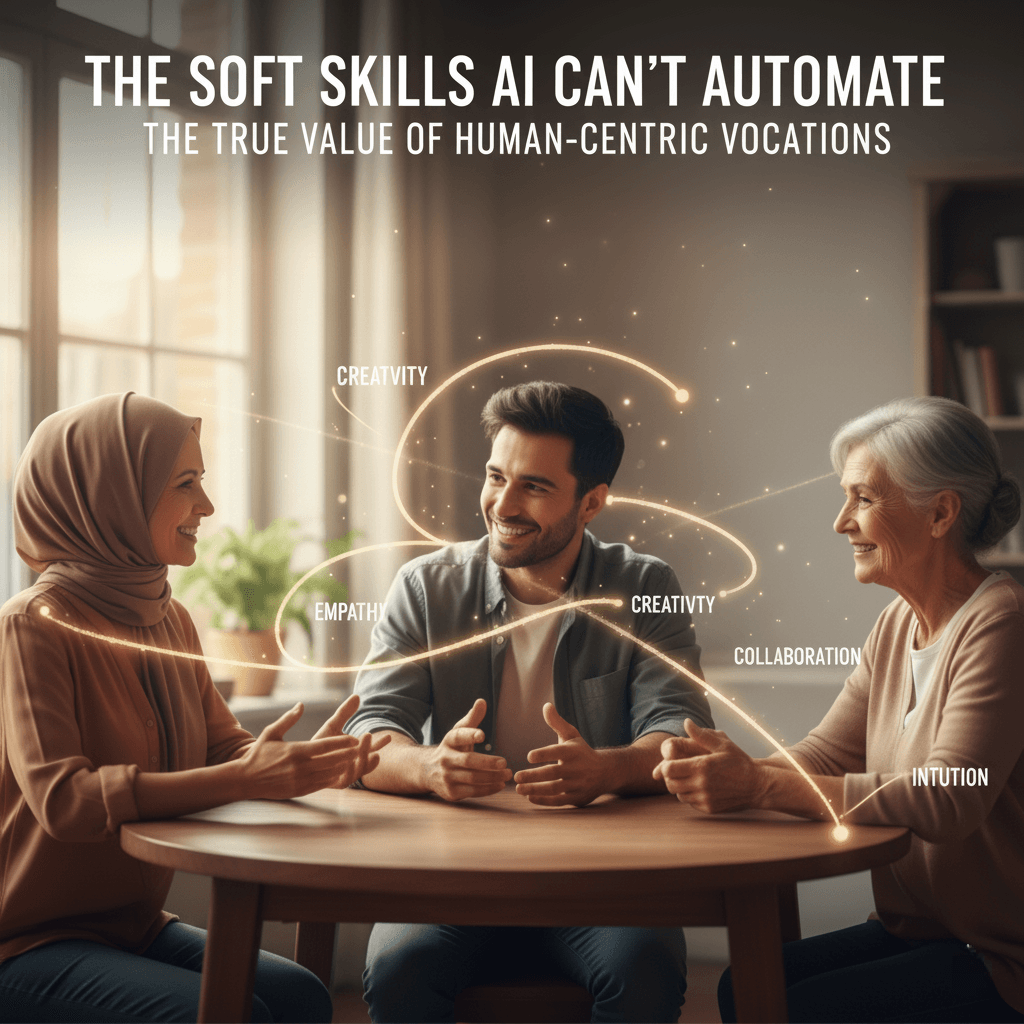
Why Human Skills Still Matter in an AI-Driven World
As artificial intelligence becomes a core part of the modern workplace, a critical question arises: What can humans still do better than machines?
The answer lies in the soft skills AI can’t automate—the deeply human abilities that power communication, empathy, critical thinking, leadership, and nuanced decision-making. These strengths form the backbone of human-centric vocations, especially in healthcare, education, hospitality, skilled trades, and customer-facing roles.
AI can replicate efficiency.
But it cannot replace emotional intelligence, trust, or the human touch.
1. Empathy & Emotional Intelligence: The Heart of Human-Centric Work
Jobs that require emotional understanding—such as nursing, counseling, caregiving, and community work—rely heavily on empathy.
AI can analyze emotions, but it cannot feel or relate to them.
Why it’s irreplaceable:
- Humans build real emotional connections
- Trust is created through empathy
- Sensitive conversations require human judgment
Vocational paths that demand emotional intelligence will always benefit from human professionals.
2. Creativity & Problem-Solving: Thinking Beyond Algorithms
AI can generate ideas, but innovative problem-solving requires intuitive creativity—something only humans possess.
In fields like:
- Media and design
- Digital marketing
- Carpentry, interior work, and craftsmanship
- Culinary and hospitality operations
Creativity helps individuals adapt, innovate, and push boundaries in ways no AI can predict.
3. Communication & Collaboration: Skills That Build Relationships
Clear communication—verbal, non-verbal, and contextual—is a core human skill.
AI might provide information, but human professionals understand tone, timing, and intent.
Industries strengthened by soft communication skills:
- Hospitality & tourism
- Sales & customer service
- Teaching & training
- Management & frontline service roles
AI can support communication, but it cannot replace the human relationship-building that drives trust and customer satisfaction.
4. Ethical Judgment & Moral Reasoning: Beyond Machine Logic
AI follows data.
Humans follow values.
Vocational roles in healthcare, public service, education, and emergency response depend on ethical decision-making—where human judgment is essential.
Example:
A paramedic doesn’t just make a decision; they evaluate risk, emotion, environment, and ethics—all simultaneously.
5. Adaptability & Leadership: Skills That Evolve With Humanity
The future of work demands adaptive professionals who can:
- Learn continuously
- Navigate uncertainty
- Lead teams through change
AI provides structure, but humans provide direction.
Leadership—formal or informal—remains a uniquely human trait enabled by intuition, motivation, and emotional awareness.
The Future Is Human + AI, Not Human vs. AI
While AI accelerates efficiency, soft skills AI can’t automate will define the workforce of the future.
This is why vocational training programs worldwide are now integrating communication, teamwork, problem-solving, and adaptability as core modules—ensuring learners become future-ready professionals.
Organizations like Meritude (subtly) support these evolving workforce needs by helping individuals acquire both technical abilities and human-centric skills that AI cannot replicate.
Conclusion: Soft Skills Are the New Superpower
As technology advances, the skills that make us human become even more valuable.
Being empathetic, creative, ethical, communicative, and adaptable will always keep vocational workers in demand—no matter how intelligent AI becomes.
This is the age where human and machine collaboration thrives, but the irreplaceable value of human-centric vocations will always stand strong.